
The question was posed by Jon Eaton in an Education Endowment Foundation (EEF) blog back in 2022, and since then the conversation has continued to evolve across education.
At the time, NASEN’s guidance document ‘Differentiation – Why and How?’ highlighted some of the practical challenges associated with traditional differentiation approaches. Importantly, however, NASEN also emphasised that there will still be pupils with SEND who need and benefit from different resources, teaching materials and strategies to access their learning.
Now, in 2026, the language of “adaptive teaching” has become much more embedded within everyday practice in schools and settings. Increasingly, staff teams are discussing adaptive teaching not simply as a new term, but as an essential approach to inclusive teaching and learning.
So, what exactly is adaptive teaching, and how does it differ from differentiation?
What Is Adaptive Teaching?
TES defines adaptive teaching as:
“Continuously assessing the strengths and needs of learners and adapting the pedagogy accordingly, through, for example, providing different levels of support, using different resources or adjusting the pace of instruction.”
To do this well places considerable demand on staff. In many ways, adaptive teaching reflects a shift away from pre-planned differentiation, where the approach, content and materials are defined advance for each group. Towards a more responsive and dynamic classroom approach, requiring staff to make ongoing adjustments throughout lessons – adapting language, pace, questioning, explanations and support in real time.
Done well, this is highly skilled practice.
The Central Role of Language
For children and young people with speech, language and communication needs (SLCN), adaptive teaching has particular significance.
‘Individualised instruction’ is a key part of adaptive teaching. And as speech and language therapists, this type of responsive, individualised support is central to our practice. We know that unless information is presented at a level a child can understand, process and retain long enough to respond meaningfully, learning is unlikely to take place effectively.
When language is inaccessible, the consequences can be significant:
- pupils may appear disengaged or inattentive
- behaviour may deteriorate
- confidence can reduce
- assessment outcomes may not reflect true ability
Importantly, this impacts both the learner and the adult supporting them.
Assessment is Key
The EEF strongly reinforces the importance of diagnostic assessment within adaptive teaching approaches:
“It’s important to remember that diagnostic assessment is crucial to adaptive teaching; teachers can only provide appropriate support if they first accurately gauge their pupils’ understanding” [Author’s emphasis]. Thinking about how, when and why assessment will be carried out over a lesson or sequence of learning is integral.”
This raises an important question for all practitioners:
How confident are we that we truly understand a pupil’s level of understanding?
Assessing and accurately identifying levels of receptive language can be harder than people think.
In the EEF blog, Jon Eaton shares his resource ‘Understanding Adaptive Teaching’.
Many pupils develop highly effective coping strategies which can mask underlying language difficulties. Some may watch peers, rely on routines or use contextual clues to navigate classroom demands, despite not fully understanding verbal instructions or teaching input.
Without careful assessment, these difficulties can easily be overlooked.
The Challenge of Questioning
One area requiring particular consideration within adaptive teaching is the use of questioning and classroom talk.
Questioning is often used as a quick way to assess understanding. However, for many children with SLCN, questions themselves may present a barrier.
If the language level of the question is too complex, pupils may:
- misunderstand what is being asked
- struggle to process information quickly enough
- provide inaccurate responses
- appear reluctant to participate
This can lead adults to make incorrect assumptions about knowledge, understanding or engagement.
Posing questions at the right level makes a significant difference!
Small adjustments – simplifying sentence structure, reducing language load, allowing additional processing time or using visual support – can make a significant difference to participation and success.
Assessing understanding is particularly tricky when pupils do not present at a developmental level where ‘traditional’ methods of assessment can be used.
How do you approach finding out what a child can understand when language levels are so low that the words alone are largely meaningless?
Or, the child is largely (or completely) non-verbal? How do we know what they know if they can’t tell us?
The issue here is that just because a child is non-verbal doesn’t mean they have ‘no language’.
Training on Blanks Levels of Questioning is available here info@soundswellspeech.com
Would you like to know more about using multi-sensory approaches?
Would it help to develop observation skills to support the accurate assessment of the most complex children?
Identifying accurate receptive language levels is just one aspect of successful adaptive teaching – but it’s a crucial one. There are tools and training available to help practitioners.
Soundswell offers SLEUTHS, a practical workshop designed to support staff in mainstream and special schools develop strategies and interventions for children with SLCN and significant needs functioning below NC Level 1.
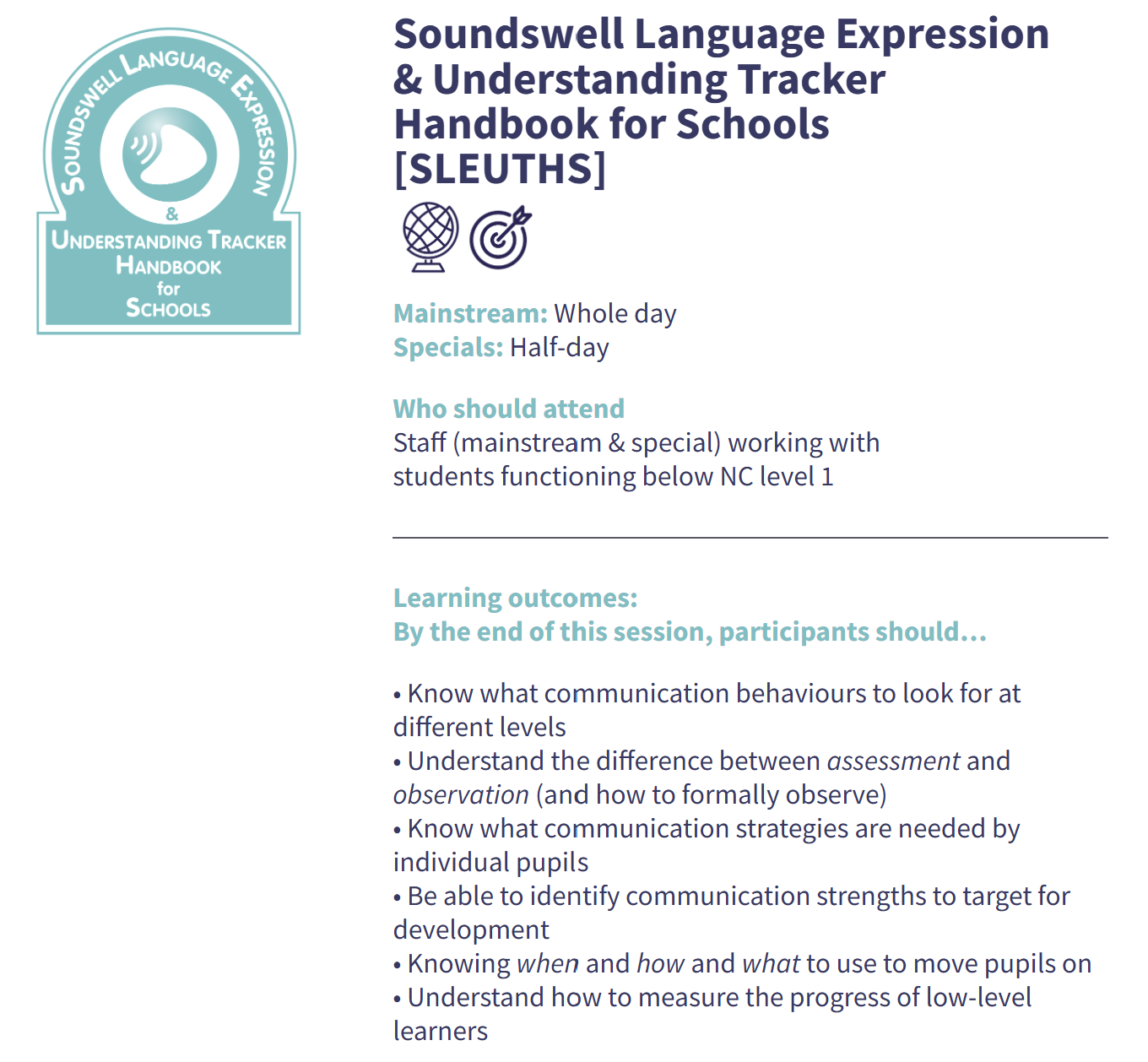
To find out more about the programme or to book your team onto a workshop, visit our SLEUTHS page.